|
Getting your Trinity Audio player ready…
|
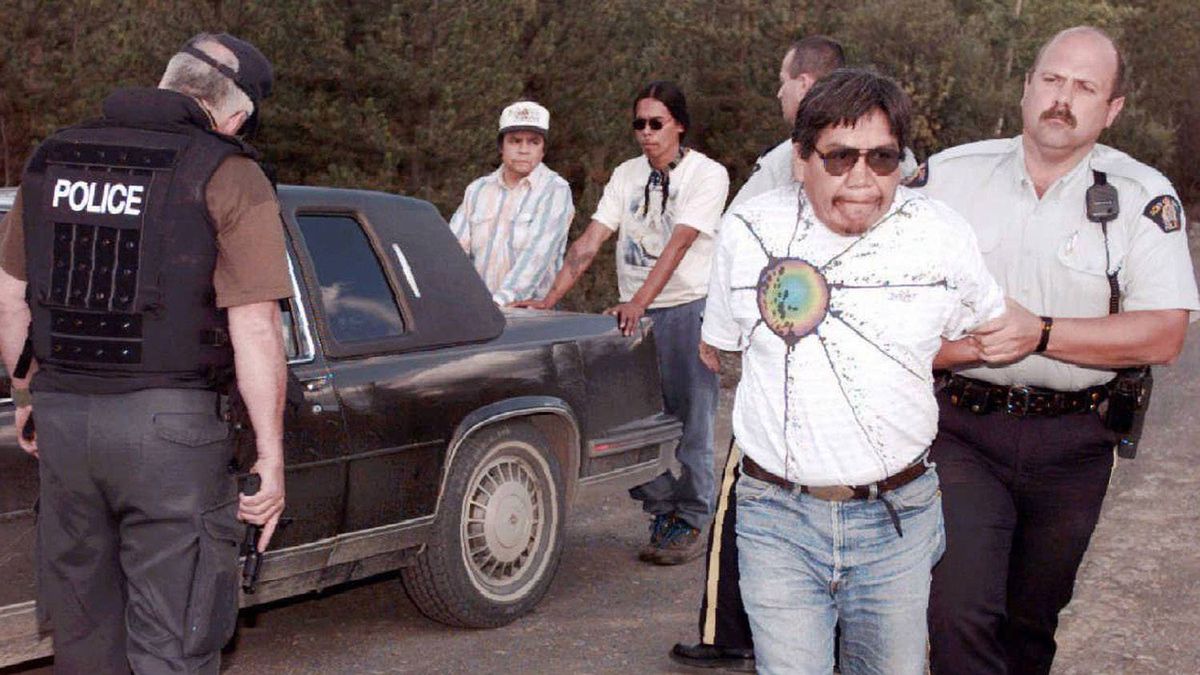
On July 27, 2026, a video circulated showing an RCMP officer repeatedly punching Indigenous woman Rose Georgina Angus in the face during an arrest on Makwa Sahgaiehcan First Nation in Saskatchewan. Blood is visible on her face. Saskatchewan RCMP issued a statement the same day asserting that Angus punched two officers, resisted arrest, and that the force used was “reasonable” after an internal review that included body-worn camera footage. She was charged with assaulting police, resisting, obstructing, and possession of cocaine. Officers had responded early that morning to a report of a drug-impaired person; two men wanted on outstanding warrants were also arrested at the same location.
The images and the official framing are familiar. They sit against a longer institutional record that includes the 1922 and 1924 actions at Six Nations of the Grand River, the 1959 RCMP raid on the Ohsweken council house, the 1990 Oka Crisis, the 2006 Caledonia reclamation, repeated development conflicts in Brantford, the 1995 Gustafsen Lake standoff in which an RCMP media officer was recorded saying “Smear campaigns are our specialty,” the targeting of Mohawk organizer Shawn Brant, and the routine use of injunctions against Indigenous rights holders—even in cases where courts themselves have noted defective titles or failures of disclosure.
What makes the current moment different on paper is the formal commitment Canada has made to the United Nations Declaration on the Rights of Indigenous Peoples (UNDRIP). In the December 16, 2021 mandate letters issued to every federal minister, Prime Minister Justin Trudeau wrote:
“Consequently, I am directing every Minister to implement the United Nations Declaration on the Rights of Indigenous Peoples and to work in partnership with Indigenous Peoples to advance their rights.”
That direction is not limited to the Minister of Public Safety or the RCMP. It applies to every minister and, by extension, to every department, agency, and function they oversee: policing and corrections, taxation and revenue, education, health, social services, natural resources, economic development and wealth generation, housing, justice, and more. The obligation is whole-of-government.
Article 26 and the land question
Article 26 of UNDRIP affirms: (1) Indigenous peoples have the right to the lands, territories and resources which they have traditionally owned, occupied or otherwise used or acquired. (2) Indigenous peoples have the right to own, use, develop and control the lands, territories and resources that they possess by reason of traditional ownership or other traditional occupation or use, as well as those which they have otherwise acquired. (3) States shall give legal recognition and protection to these lands, territories and resources. Such recognition shall be conducted with due respect to the customs, traditions and land tenure systems of the indigenous peoples concerned.
Other articles reinforce the point. Article 7 protects life, physical and mental integrity, liberty and security of person. Article 19 requires free, prior and informed consent. Article 37 requires recognition and enforcement of treaties. Article 40 guarantees access to just procedures and effective remedies.
Because the mandate letters directed every minister to implement UNDRIP, these obligations extend across the full range of government activity—policing, taxation, education, health, social programs, corrections, resource extraction, and economic development.
Continuity of practice
The North-West Mounted Police was created in 1873 to extend Canadian authority westward. It became the RCMP in 1920. On Six Nations, RCMP officers participated in the 1922 alcohol raids and the events of October 1924.
A common misconception holds that the 1924 Order-in-Council dissolved the Haudenosaunee Confederacy government. It did not—and could not. One government cannot dissolve another. What Canada actually did was amend and apply its own Indian Act framework so that the Canadian state would no longer recognize the traditional Confederacy Council. In its place it recognized only an elected band council of its own creation. On October 7, 1924, the Indian Agent, accompanied by RCMP officers, entered the Council House at Ohsweken, read the Order-in-Council, and announced that Canada would thereafter deal only with the new structure. Historic documents and wampum were seized. The Confederacy was not extinguished; Canada simply withdrew recognition and enforced its preference through police presence.
In March 1959 supporters of the hereditary chiefs occupied the council house and declared the traditional government restored. On March 13, approximately 50 RCMP officers surrounded the building, entered the packed chamber, and ordered everyone out. There was a scuffle. Four men were arrested that night; others were later summonsed. Clan mothers confronted the officers. The force reasserted control on behalf of the elected system Canada chose to recognize.
The pattern continued at larger scale. In 1990 the Oka Crisis (Kanesatake Resistance) erupted when the Town of Oka moved to expand a golf course and build townhouses on disputed land that included a Mohawk burial ground in the Pines. After injunctions were ignored, the Sûreté du Québec raided the barricade on July 11. Corporal Marcel Lemay was killed in the exchange of fire; the shooter was never identified. The 78-day standoff drew in the RCMP and the Canadian Army. The golf expansion was eventually cancelled and the land purchased by the federal government, but the underlying land claim remains unresolved.
In February 2006 members of Six Nations began the reclamation of the Douglas Creek Estates development site in Caledonia, asserting rights under the Haldimand Proclamation. The developer obtained injunctions. The OPP’s enforcement was limited. Ontario later purchased the land. Court proceedings featured strong judicial language about the “rule of law” and contempt, even as the province moved to negotiate. The occupation highlighted the gap between court orders and the political reality of unresolved title.
Similar dynamics have played out in Brantford and across the Haldimand Tract. Municipalities and developers have repeatedly sought and obtained injunctions against Haudenosaunee land defenders and the Haudenosaunee Development Institute. Courts have sometimes described asserted title claims as “exceedingly weak” while simultaneously noting historical surrenders, long periods of private ownership, and the doctrine of bona fide purchaser. At the same time, private litigation has revealed failures of disclosure: developers have sued municipalities for not revealing the existence or strength of Aboriginal claims before land purchases closed. The result is a recurring contradiction—injunctions are granted against Indigenous rights holders even when judicial language elsewhere acknowledges defective titles or the city’s obligation to disclose the very claims that make the development contested.
The same approach to narrative and reputation appears in other cases. During the 2007 National Day of Action blockades involving Mohawk activist Shawn Brant of Tyendinaga Mohawk Territory, wiretap transcripts captured then-OPP Commissioner Julian Fantino telling Brant that “your whole world’s going to come crashing down” and that he would “do everything I can within your community and everywhere to destroy your reputation.” A temporary publication ban restricted reporting on parts of the evidence; material circulated (including through WikiLeaks-related channels) before the restriction was lifted. At Gustafsen Lake in 1995 an RCMP officer on an internal recording stated “Smear campaigns are our specialty.”
The municipal level: where the rubber meets the road
Municipal elections are approaching in many Ontario communities that sit on or adjacent to the Haldimand Tract and other contested lands. City and town councillors, mayors, and local staff are the ground-level face of government for most day-to-day interactions between Indigenous people and the Crown’s administrative structure. They approve developments, pass by-laws, seek or enforce injunctions, manage planning departments, and coordinate with police. This is where abstract policy becomes concrete: a housing subdivision, a road widening, a by-law prohibiting “interference,” or a call for OPP assistance.
These local officials operate inside the same constitutional and political structure that includes the federal ministers who received the 2021 UNDRIP mandate letters. The chain of responsibility runs from the Prime Minister’s direction to every federal minister, through provincial counterparts (including the Solicitor General responsible for the OPP), and down to the municipalities that exercise delegated authority over land use and local order. In theory, the obligation to implement UNDRIP and to work in partnership with Indigenous peoples travels with that authority.
In practice, the municipal level is often where understanding of that obligation is thinnest. Many local politicians and staff treat Indigenous land rights, treaty relationships, and free, prior and informed consent as distant federal or provincial concerns rather than live constraints on their own decisions. The result is a recurring pattern: developments proceed, injunctions are sought against Haudenosaunee land defenders, disclosure of outstanding claims is incomplete or contested, and the “rule of law” is invoked in ways that treat Indigenous assertion of rights as disruption rather than as the exercise of pre-existing title and jurisdiction.
This is not a claim that every municipal councillor is personally hostile. It is an observation about structural position. The municipal tier is the lowest formal level of the governmental hierarchy that still carries the legal and political duty to maintain coherence with the higher commitments Canada has made. When that duty is poorly understood or routinely set aside, the federal mandate becomes decorative. The same state that tells its ministers to implement UNDRIP continues, through its municipal instruments, to facilitate development on contested lands and to police the people who object.
The upcoming municipal elections therefore matter beyond ordinary local issues. Candidates and voters in Brantford, Haldimand, Caledonia, and neighbouring communities are choosing the people who will sit at the precise point where Crown authority and Indigenous rights meet on the ground. Whether those officials recognize that they, too, sit inside a chain of duty that includes the UNDRIP mandate will help determine whether the pattern of injunctions, non-disclosure, and force continues or begins to change.
The gap between mandate and practice
A mandate letter is not self-executing. Implementation requires measurable change across every portfolio: use-of-force policy, tax and revenue practices that respect Indigenous jurisdiction, education and health systems that do not undermine Indigenous control, economic and resource decisions that meet free, prior and informed consent, and social programs delivered in partnership rather than imposed. It requires that Article 26 shape operational decisions rather than remaining rhetorical. It requires that the right to physical integrity under Article 7 constrain state conduct rather than yield to internal determinations of reasonableness.
When any minister is directed to implement UNDRIP and an agency under that minister’s portfolio—or a municipality exercising delegated authority—continues practices that leave Indigenous people bloodied, seize governance institutions, target organizers’ reputations, issue injunctions against rights holders while acknowledging defective titles elsewhere, or extract wealth without consent, the mandate is not being fulfilled. The existence of the whole-of-government direction makes the failure more significant. It converts what might once have been defended as ordinary administration into a contradiction of stated government policy and of international standards Canada has undertaken to uphold.
The video from Makwa Sahgaiehcan is one incident. The history that surrounds it—from the 1920s actions through 1959, Oka, Caledonia, Brantford injunctions, the Fantino–Brant transcripts, Gustafsen Lake, and the present—is longer. The political commitment that is supposed to govern the full machinery of the state, including its municipal instruments, is now explicit. The question is whether that commitment will remain a sentence repeated in mandate letters or become a real constraint on the exercise of power on Indigenous lands and over Indigenous lives.
Leave a Reply